Showing posts with label American. Show all posts

Monday, March 21, 2011

2011 Detroit Auto Show: Ford C-Max Energi and C-Max Hybrid


Ford has unveiled two new C-MAX hybrids at the North American International Auto Show.

The C-Max is essentially the same thing as the Grand C-Max that other markets get with its three-rows of seats and sliding rear doors. The C-Max Hybrid and C-Max Energi are actually based on the shorter-wheelbase five-passenger C-Max that is sold in Europe.

The C-Max Hybrid uses the Blue Oval's next-generation gasoline/electric powertrain technology, and we're told that fuel economy will be higher than the 41 miles per gallon that's currently on tap in the Fusion Hybrid sedan. By building upon the powersplit technology currently used in the automaker's hybrids, Ford says that the C-Max Hybrid will be able to operate in electric mode at speeds higher than 47 miles per hour.

Both hybrids are derivatives of the 2012 C-Max, a compact crossover that shares its underpinnings with the redesigned 2012 Ford Focus.


2014 Ford C-MAX Energi 2014 Ford C-MAX Energi 2014 Ford C-MAX Energi 2014 Ford C-MAX Hybrid 2014 Ford C-MAX Hybrid 2014 Ford C-MAX Hybrid


Press Release

FORD SUPERCHARGES ELECTRIC VEHICLE PLAN, UNVEILING NEW C-MAX ENERGI AND C-MAX HYBRID PRODUCTS

  • Ford will launch C-MAX Energi, its first-ever production plug-in hybrid electric vehicle, and C-MAX Hybrid, a full hybrid variant, in North America in 2012 and Europe in 2013
  • Both versions of the five-passenger multi-activity vehicle will leverage the company's global C-car platform, critically acclaimed powersplit hybrid architecture, next-generation driver information features and advanced, lighter and smaller lithium-ion (Li-ion) battery systems
  • C-MAX Hybrid is targeted to deliver better miles per gallon than Ford Fusion Hybrid, the most fuel-efficient sedan in America
  • C-MAX Energi targets more than 500 miles (800 kilometers) of driving range using the battery and engine, more than any other plug-in or extended-range vehicle. It also targets AT-PZEV status and delivers better charge-sustaining fuel economy than Chevrolet Volt

Detroit, Jan. 10, 2011 - Ford today revealed two next-generation hybrid vehicles - including its first production plug-in hybrid electric vehicle - at the 2011 North American International Auto Show, bringing consumers more choice, versatility and style for high-mileage family-friendly vehicles.

Ford C-MAX Energi plug-in hybrid and C-MAX Hybrid are based on the new Ford C-MAX five-passenger multi-activity vehicle, and each will offer high mileage and low emissions as well as distinctive body design and a flexible interior. The plug-in hybrid and third-generation full hybrid leverage Ford's global C-car platform, acclaimed powersplit architecture, next-generation driver information features and advanced lithium-ion battery systems.
"C-MAX Energi and C-MAX Hybrid will be perfect for families looking to maximize their hybrid car experience," said Nancy Gioia, Ford director of Global Electrification. "Thanks to the versatile interior, these cars are going to appeal to environmentally conscious consumers who need room to grow."

C-MAX Hybrid is targeted to deliver better fuel economy than the 41 mpg Ford Fusion Hybrid, the most fuel-efficient sedan in America today. It builds on the success of the critically acclaimed powersplit architecture Ford uses in its current hybrids, allowing it to operate in fuel-saving electric mode beyond 47 mph.

Both the C-MAX Energi and C-MAX Hybrid models will be built alongside the all-new 2012 Ford Focus and Focus Electric at Ford's Michigan Assembly Plant in Wayne, Mich. The plant's production is powered in part by one of the largest solar energy generator systems in the state. The C-MAX Energi and C-MAX Hybrid vehicles sold in Europe in 2013 will be built at Ford's plant in Valencia, Spain, starting in 2013.

The plug-in advantage
Targeted to achieve AT-PZEV (Advanced Technology Partial Zero Emissions Vehicle) status, C-MAX Energi provides maximum fuel efficiency by pairing a high-voltage lithium-ion battery and electric traction motor with a high-efficiency Atkinson-cycle gasoline engine. This allows it to run in electric mode before using the gasoline engine.

C-MAX Energi will offer more than 500 miles (800 kilometers) of overall driving range using the battery and engine - more than any other plug-in or extended-range electric vehicle. C-MAX Energi delivers better charge-sustaining fuel economy than Chevrolet Volt.

In general, plug-in hybrid vehicles offer several benefits, including:

  • Electric driving range, perfect for emissions-free and silent city driving
  • Potential consumer savings on energy and fuel costs thanks to improved fuel efficiency over a standard hybrid
  • Reduced dependency on petroleum and increased energy independence
  • Reduced environmental impact through reductions in greenhouse gas emissions
  • Increased use of electricity from renewable energy sources (e.g. wind and solar), where available, for vehicle recharging

"A plug-in hybrid owner may make fewer trips to the pump to refuel because of its all-electric mode capability," said Derrick Kuzak, Ford vice president of Global Product Development. "Conveniently, they'll be able to recharge their plug-in hybrid at home overnight. And they'll never have to think about the vehicle's electric range, because the plug-in hybrid seamlessly shifts to fuel power when needed."

The development of Ford's first-ever production plug-in hybrid leverages more than 200,000 miles of road testing conducted in collaboration with a coalition of 10 utility companies, the U.S. Department of Energy, the New York State Energy Research and Development Administration and the Electric Power Research Institute.

Getting charged up
C-MAX Energi and C-MAX Hybrid will use advanced lithium-ion battery systems developed and assembled in-house by Ford in Michigan. Each system is smartly designed to maximize use of common, high-quality components, such as control board hardware that has proven field performance in Ford's current, critically acclaimed hybrid vehicles.

Li-ion battery packs offer a number of advantages over the nickel-metal-hydride (NiMH) batteries that power today's hybrid vehicles. In general, they are 25 to 30 percent smaller and 50 percent lighter, which makes them easier to package in a vehicle, and can be tuned to increase power to boost acceleration or to increase energy to extend driving distance.

While C-MAX Hybrid will operate much like today's hybrid vehicles, C-MAX Energi will benefit from daily charging to maximize its all-electric range. Thanks to the efficiencies of its right-sized battery system, the plug-in hybrid easily recharges 100 percent overnight on a 120-volt outlet.

A full charge in C?MAX Energi allows owners to increase their driving significantly in all-electric mode and drastically reduce their use of the on-board fuel engine.

On start-up, C-MAX Energi will operate in charge-depletion mode, providing electric driving range. When the battery has been depleted or certain conditions are met, it switches to charge-sustaining hybrid mode for continued optimal fuel efficiency.

Ford worked with a supplier to provide an industry-standard five-point plug for C-MAX Energi (and new Focus Electric) that is ergonomically comfortable to hold as well as durably and distinctively designed. The plug handle uses a matte-finished black rubber for a comfortable, non-slip grip and the plug head is shielded with a glossy white hard plastic to protect the electronics. The Ford Blue Oval trademark helps make the device immediately recognizable.

When the cord set connector is plugged into the vehicle's charge port, which is located conveniently between the driver's door and front wheel well, it activates a light ring that loops around the port twice in acknowledgement of connectivity. The light ring then illuminates in quadrants as the vehicle charges. Flashing quadrants represent charge in progress and solid-lit quadrants show stages of charge completion. When the entire ring is solidly lit, the vehicle is fully charged.

Smarter interface
C-MAX Energi owners will have access to a suite of driver information systems - on-board and off-board - designed to help them manage the recharge process, manage the most eco-friendly route on-board, remotely control their vehicle's charge and preconditioning settings, monitor battery state of charge and maximize energy efficiency to extend use of electric mode. C-MAX Hybrid owners also will benefit from the on-board features.

Among these tools is a unique execution of MyFord TouchTM driver connect technology, especially for electrified driving. It offers exceptional configurability of vehicle information, including fuel level, battery power level, and average and instant miles per gallon.

The cluster's new MyView feature allows drivers to access even more vehicle data such as the electrical demands of vehicle accessories, including air conditioning, which influences fuel economy and the electric driving range of the C-MAX Energi.

The Brake Coach feature helps to educate drivers to optimize their use of the regenerative brakes to recapture kinetic energy and send it back to the battery, also reducing wear on the brakes.

Long-term fuel efficiency can be displayed in two ways - either as a traditional chart or using an innovative display that shows a growing leafy vine on the right side of the cluster. The more efficient a customer is, the more lush and beautiful the leaves and vines become, creating a unique visual reward for the driver's efforts.

To reinforce the message, at the end of each trip a display screen provides distance driven, miles gained through regenerative braking, fuel consumed (average and total) and a regenerative braking score.

New MyFord Mobile
Off-board, C-MAX Energi owners in North America can maintain constant contact with the car anywhere they have mobile phone or web access using the Ford-developed MyFord Mobile.

MyFord Mobile enables access to a secure Ford website and smartphone/feature phone app to get instant vehicle status information, perform key functions remotely, monitor the car's state of charge and current range, get various alerts including when the vehicle requires charging, remotely program charge settings and download vehicle data for analysis.

The feature also allows the owner to program the vehicle to use electricity from the grid to heat or cool the battery and cabin while plugged in. For example, during hot summer months, owners can preprogram the car the evening before to be fully charged - and fully cooled to a particular temperature - by a certain time the following morning. Users can also locate the vehicle with GPS, remotely start the vehicle, and remotely lock and unlock the car doors.

Working with MapQuest®, MyFord Mobile can communicate charge station and other points of interest to C-MAX Energi using SYNC's Traffic, Directions and Information (TDI) service. Turn-by-turn guidance is provided by the in-car map-based Navigation System. Drivers can also get up-to-date charging station information in their vehicle directly through SYNC TDI simply by connecting to SYNC Services.

Value charging, powered by Microsoft
Using the value charging feature, powered by Microsoft, C-MAX Energi owners in North America will be able to optimize their home's energy use and vehicle recharging practices. Value charging allows Ford customers to reduce their electricity costs by taking advantage of off-peak or reduced rates from their utility without a complicated set-up process.

"Although C-MAX Energi owners won't have to plug in, by doing so they'll get the benefits of driving in electric mode for longer distances; that can mean fewer trips to the gas station and less emissions when driving," said Sherif Marakby, director of Ford's hybrid and electric programs. "That's why we'll be providing C-MAX Energi and C-MAX Hybrid owners with a user-friendly interface and tools like value charging that will help them get the most out of the vehicle's electric mode capability."

Proven powersplit technology
C-MAX Energi and C-MAX Hybrid build on the success of the critically acclaimed powersplit architecture Ford uses in its current hybrids, including the Ford Fusion Hybrid, winner of the 2010 MOTOR TREND Car of the Year® award.

In a powersplit hybrid, the electric motor and gasoline-powered engine can work together or separately to maximize efficiency. The engine also can operate independently of vehicle speed, charging the batteries or providing power to the wheels as needed. The motor alone can provide sufficient power to the wheels in low-speed, low-load conditions, and work with the engine at higher speeds.

While this system enables the current Fusion Hybrid to operate in fuel-saving electric mode up to 47 mph, Ford is targeting higher electric operating speeds for C-MAX Hybrid and even more capability for C-MAX Energi, which will have the advantage of additional battery power.

Ford's global C-car strategy
C-MAX Energi and C-MAX Hybrid are two of at least 10 new models or derivatives that Ford will launch around the world based on its new global C-car platform - Ford's first truly global One Ford platform.

Ford's new generation of C-segment vehicles will be sold in more than 120 markets and will account for more than 2 million units annually. The C-segment accounts for one in four cars sold worldwide today and, in conjunction with the B-segment, is expected to rise to 50 percent of all cars sold globally by 2013.

The all-new C-MAX lineup also introduces a number of advanced new technologies to the compact multi-activity vehicle class. More often found only on larger or more premium cars, these technologies are focused on enhanced comfort, safety and sustainability, including the availability of new and powerful, yet highly fuel-efficient, low-CO2 Ford EcoBoostTM gas engines.

The previous European C-MAX established a reputation for providing a balance of enjoyable driving dynamics and impressive comfort. The all-new model is set to take that performance to a new level, giving drivers a class-leading combination of responsive, sporty handling and overall refinement approaching the standards usually associated with larger, luxury vehicles.

C-MAX Energi and C-MAX Hybrid are two of five electrified vehicles that Ford will bring to the North American market during the next two years. In addition, the Ford Transit Connect Electric small commercial van, built in collaboration with Azure Dynamics, began initial production at the end of 2010, and Focus Electric will launch in late 2011. A second next-generation hybrid electric vehicle will be announced later and available in North America and Europe in 2012.

2011 Baldwin-Motion Camaros


Baldwin-Motion has released details on a series of 5 special models based on the 2011 Camaro SS.

The 800 HP upgrade package will include a 2.8-liter Twin-Screw supercharger system, eight-rib supercharger drive assembly, unique block, 4.125-inch bore, pressed-in liners, forged 2618 Aluminum 9.3-to-1 pistons, forged 6.125-inch H-Beam Steel connecting rods, forged 4.00-inch stroke steel crankshaft, race-prepped CNC-ported aluminum heads, custom Redline R3-SC Blower camshaft, ATI/Redline damper, high-efficiency tubular exhaust system and an upgraded TR6060 six-speed manual transmission.

Available through DeNooyer Chevrolet in upstate New York, customers will have a choice of cars ranging from the SS-427 (dyno-rated at 525hp), or the 427-SC Supercar (dyno-rated at 800 horsepower). The 2011 Camaro SS Phase III cars will start at under $80,000 and go up from there. It should be interesting to see how things actually run, especially since Chevrolet is working on their own 550+ hp Camaro Z/28 that’s set to debut for the 2012 model year.


2011 MOTION Phase III SC-427 Supercar 22011 MOTION Phase III SC-427 Supercar 22011 MOTION Phase III SC-427 Supercar 22011 MOTION Phase III SC-427 Supercar 2


Press Release

RETURN OF THE FANTASTIC FIVE:
MODERN MUSCLE CARS WITH LEGENDARY HERITAGE!


Baldwin-Motion's Joel Rosen partners with DeNooyer Chevrolet's Performance Division and Redline Motorsports to build and market 2011 MOTION 427 and 454 Camaros.

More than 40 years ago Joel "Mr. Motion" Rosen, a young Brooklyn dyno-tuner, hot rodder, street racer and national record holding drag racer, turned a simple 427 Camaro engine swap into an empire. And catapulted Baldwin-Motion and MOTION into internationally respected performance brands. Working with Baldwin Chevrolet, he was the most prolific builder-marketer of modified new big-block Chevys during the Supercar ‘60s & ‘70s. He backed up Phase III models with written money-back performance warranties! He's now passing the torch to Howard Tanner, a young dyno-tuning specialist and speed shop owner.

"It's Déjà Vu all over again," said Joel Rosen, quoting the legendary Yankee, Yogi Berra. "We have re-launched the Baldwin-Motion and MOTION brands again, this time capturing the true spirit of what we did in 1967-1974: Market built-to-order, dyno-proven and warranted SS & Phase III 427 & 454 Camaros, crafted by a high-tech dyno shop and available exclusively from a single authorized Chevrolet dealer."

Specially prepared 427 and 454 engines power the latest iterations of the legendary Baldwin-Motion Fantastic Five : 2011 SS & Phase III Camaros, dyno-rated at 525 (SS-427) to 800 horsepower (427-SC Supe rcar). Howard Tanner is President of Redline Motorsports, a speed shop specializing in fuel-injected vehicles in Schenectady, NY. He and his team are the builders. Dan Carlton, General Manager, DeNooyer Chevrolet's Performance Division in Albany, NY is handling client contact.

DeNooyer Chevrolet, owned by second-generation Chevrolet dealer Jim DeNooyer, is the highest volume Chevrolet dealership in upstate New York. As a young, hands-on car guy, DeNooyer was into hot rods, customs and drag racing. He later moved up into fast boats and has held speed records since the 1990s. Sons, Joel and Tom, also high-performance enthusiasts, handle day-to-day operations.

"It's great that the folks at DeNooyer Chevrolet and Redline Motorsports have embraced the Baldwin-Motion heritage of using the latest GM 427 and 454 high-performance factory engines in their new MOTION Camaros," said Dr. Jamie Meyer, Product Integration Manager, General Motors Performance Parts.

Tanner is a highly skilled engine calibrator and dyno-tuner as well as an experienced builder of large-displacement GM vehicles, including Camaros and Corvettes. Carlton, a respected racer, successful GM of luxury brand dealerships and former Chevrolet dealership principal, has years of experience selling both imported and domestic high-performance vehicles. He is a former New York State Ice Racing Champion and currently competes in sports car, ice racing and Modified motorsports.

Every MOTION Camaro will be built to order at Redline and tuned by Howard Tanner on its DYNOmite 1,400 horsepower Eddy Current Load dyno. A full dyno report as well as official Baldwin-Motion documentation will go with each car.

Sanctioned, serialized and signed by Joel Rosen, each 2011 MOTION SS & Phase III Camaro will be delivered with custom MOTION VIN plates and complete documentation. To prevent future cloning of MOTION Camaros, Rosen and Carlton will be establishing a confidential MOTION Registry detailing VINs, vehicle specifications and original purchaser data.

In 1967-1968, Baldwin-Motion marketed its full line of 427 Chevys under The Fantastic Five banner. Advertising and marketing materials, as well the windows at Baldwin Chevrolet, screamed The Fantastic Five. And, that's how they're launching the new line of 2011 MOTION Camaros.

The 2011 Fantastic Five : SS-427 (525 HP), Phase III 427 (600 HP), SS- 454 (550 HP), PHASE III 454 (625 HP Torque Monster!) and PHASE III 427- SC (800 HP Supercharged Supercar). Complete details can be found at http://www.officialbaldwinmotion.com/

"I like to think of our 2011 SS and Phase III 427 & 454 Camaros as "modern MOTION mythmakers!" said, DeNooyer's Carlton.

When Rosen and MOTION LLC's Larry Jaworske and Joel Ehrenpreis re-launched the Baldwin-Motion and MOTION brands in 2005, they set a new standard for 1969 "continuation" Camaros. The Launch Edition two-seat SuperCoupe, powered by a front/mid-mounted, fuel-injected 540-inch aluminum big-block, won the coveted GM Design Award at SEMA 2005 and set a record at Barrett-Jackson in 2006.

"We produced extremely expensive, coachbuilt Camaros between 2005-2009. This time it's different. Our new MOTION 427 & 454 Camaros are much more affordable and drivable, starting at under-$80,000, and will be hard to beat on the street or at a show. I've ordered the first one (#001), a limited-production, 800-horsepower supercharged Phase III 427-SC Supercar," said Rosen.

2011 Hennessey HPE600【Video】


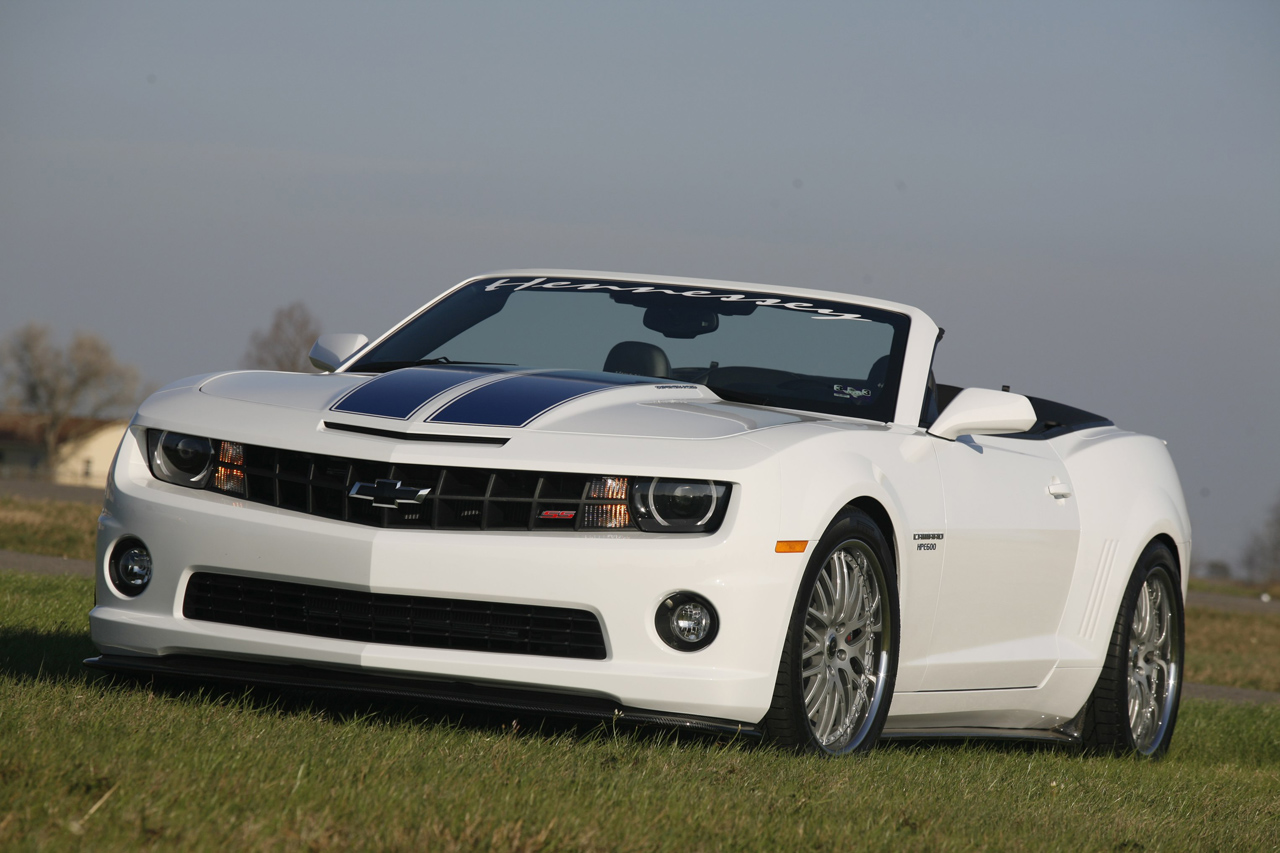
Hennessey Performance Engineering is offering a 602-horsepower supercharger upgrade for the 2011 Camaro SS Convertible, This 602 bhp street monster makes its power by way of a TVS2300 supercharger system with cold air induction, stainless steel long tube headers,high flow catalytic converters, stainless steel mid-pipes and high flow fuel injectors. The suspension has also been massaged by way of a KW adjustable coil-over suspension system.

The 2011 Hennessey HPE600 Camaro convertible is a bit less potent than last year model. It is based on the 2011 Camaro SS convertible, which Hennessey added a supercharger to the V8 engine to produce 602 horsepower. That’s about 172 horsepower more than the Camaro SS production model.

The HPE600 package is priced from $15,995 (€11,470) but customers can add a variety of options including a carbon fiber body kit, an adjustable KW coilover suspension, and 20-inch alloy wheels with Michelin Pilot Super Sport or Pirelli P-Zero tires.


Hennessey HPE600 Hennessey HPE600 Hennessey HPE600 Hennessey HPE600 Hennessey HPE600 Hennessey HPE600 Hennessey HPE600 Hennessey HPE600


Press Release

Introducing the 2011 HPE600 Supercharged Camaro Convertible


SEALY, TEXAS - Hennessey Performance (HPE) introduces the company's first 2011 HPE600 Supercharged Camaro convertible. Pounding the pavement with a 602 bhp supercharged V8, the HPE600 is also the first 2011 Chevrolet Camaro convertible to hit the streets with a full treatment of aftermarket performance upgrades.

Hennessey began offering its power-addicting upgrades to the latest Chevy Camaro when the car was introduced in April of 2009. Since that time, HPE has built hundreds of Camaros with over 550 horsepower for owners across the globe.

"We were excited to receive one of the first 2011 Camaro SS convertibles from Chevrolet," says company founder and president, John Hennessey. "It was only natural that we would take the new Camaro SS convertible and upgrade it with our very popular HPE600 Supercharged upgrade. If having a 602 horsepower Camaro is cool and fun to drive then being able to drop the top takes the sensation of speed and the classis sound of American-muscle to a whole new level."

The 2011 HPE600 Supercharged Camaro convertible puts its additional power to the ground with the help of a lowered (1 inch) KW adjustable coilover suspension system. Combined with wider 20 inch wheels (9.5 x 20 inch fronts, 10.5 inch rears) riding on Michelin Pilot Super Sport tires (275/30-20 fronts, 305/30-20 rears), the HPE600 Camaro convertible is capable of going from 0-60 mph in just 3.9 seconds while running through the quarter mile in 12.0 seconds @ 118 mph.

"The new convertible Camaro is about 250 lbs heavier than the hardtop," states Hennessey CEO, Don Goldman. "But when you add nearly 200 horsepower, it more than makes up for the increased weight. When you are cruising down your favorite road with the top down, the combined sound of supercharger and exhaust makes it all worth it!"

The base cost for the HPE600 Supercharged Camaro convertible is $56,495 (base Camaro SS convertible MSRP of $40,500 plus $15,995 for the HPE600 Supercharged upgrade). All HPE600's come with a 3-year / 36,000 mile powertrain warranty from Hennessey. All-in, the HPE600 Supercharged Camaro convertible with upgraded wheels, tires, suspension and CarbonAeroTM carbon fiber front splitter and side sills costs $74,950 plus tax, title and license.

Camaro hardtop and convertible owners can send their vehicles to Hennessey facilities located near Houston, Texas and Lake Forrest, California. New vehicles can also be purchased through authorized Hennessey dealers such as Parkway Chevrolet (www.parkwaychevrolet.com ) in Tomball, Texas.


2011 HPE600 Supercharged Camaro Convertible
Vehicle Specifications


Power:
  • 602 bhp @ 6,300 rpm
  • 605 lb-ft torque @ 3,800 rpm

HPE600 Supercharged Upgrade Includes:
  • TVS2300 Supercharger System (Black)
  • HPE Cold Air Induction System
  • Stainless Steel Long Tube Headers
  • High Flow Catalytic Converters
  • Stainless Steel Mid-Pipes
  • High Flow Fuel Injector Upgrade
  • Professional Installation
  • HPE Engine Management Calibration
  • Dyno Tuning & Road Testing
  • Hennessey & HPE600 Exterior Badging
  • Serial-Numbered Dash & Engine Plaques
  • Hennessey Premium Floormats
  • Hennessey Embroidered Headrests
  • HPE Modified Engine Cover
  • 3 Year / 36,000 Mile Limited Warranty

Options Include:
  • CarbonAero Front Splitter (real carbon fiber)
  • CarbonAero Side Sills (real carbon fiber)
  • Hennessey / KW Variant 1 Suspension Upgrade (lowered 1 inch)
  • Hennessey Blue Hood Stripes
  • Hennessey 3-Piece Alloy Wheels (20×9.5 in. front, 20×10.5 in. rear)
  • Pirelli P-Zero Tires (275/30-20 front, 305/35-20 rear)
  • Hennessey Carbon Fiber Door Sill Plates

2012 Buick Regal Hybrid


General Motors has unveiled the Buick Regal Hybrid at the Chicago Auto Show.

The Buick Regal Hybrid is expected to have similar consumption figures as the LaCrosse, as the e-Assist will enable a 25 percent boost in efficiency. This means that the 2.4-litre 4-cylinder engine powering the Buick Regal Hybrid which will use a six-speed transmission will most probably return around 31 mpg (combined cycle) / 7,9-litres per 100 Km.

The same 17-inch lightweight alloy wheels (and low rolling resistance tires) are used on both Buicks. Thanks to the Regal’s smaller size, however, the wheels don’t appear as undersized as they do on the LaCrosse. If the driver is in an especially green mood, the car can be put into a fuel economy optimizing mode with the AC unit that allows for more frequent and longer engine stop periods.

The Buick Regal with e-Assist is more likely to be marketed as a premium engine choice for buyers of the compact sedan, unlike the current setup for the LaCrosse full-size four-door where the hybrid version has become the vehicle’s entry-level model. GM has cited cost concerns which prevent the Regal from enjoying the same ultra-thrifty base drivetrain.


2012 Buick Regal Hybrid2012 Buick Regal Hybrid2012 Buick Regal Hybrid2012 Buick Regal Hybrid2012 Buick Regal Hybrid2012 Buick Regal Hybrid


Press Release

2012 Regal to Offer New eAssistTM Fuel-Saving Technology

  • eAssist "light electrification" system improves fuel economy 25 percent
  • Estimated 26 mpg city / 37 mpg highway (pending EPA certification)
  • On sale this fall
CHICAGO - Buick announced the 2012 Regal with eAssistTM fuel-saving technology, which improves overall fuel economy by 25 percent over the 2011 four-cylinder/six-speed powertrain. Estimated fuel economy is 26 mpg city and 37 mpg on the highway (pending EPA certification).

Regal with eAssist joins the 2012 LaCrosse as the second Buick to feature the efficiency-enhancing technology. The system uses a state-of-the-art lithium-ion battery system, electric induction motor-generator and regenerative braking capability to improve fuel economy. Its fuel economy tops competitors such as the Acura TSX, rated at 22 mpg city and 31 mpg highway. Regal's estimated 37 mpg on the highway is 20 percent greater and the TSX doesn't offer a six-speed automatic transmission, which is standard on the Buick.

"Buick's eAssist technology means customers don't have to trade a premium driving experience for efficiency," said Tony DiSalle, vice president of Buick marketing. "We believe Regal and LaCrosse with eAssist provide more logical and affordable choices, compared to other hybrid midsize and full-size luxury sedans."

Regal with eAssist goes on sale this fall. It joins an expanding lineup that also includes 2.4L and 2.0L Turbo (with manual transmission) models, as well as the upcoming Regal GS. Regal with eAssist offers the range of luxury and convenience packages offered in the other models, along with unique features that include:

Lightweight 17-inch alloy wheels and tires with lower rolling resistance
A driver-selectable, fuel economy-optimizing mode for the air conditioning system, which enables more frequent and longer-duration engine stop periods
An ECO gauge on the instrument panel that continuously responds to driving behavior, enabling the driver to drive with greater efficiency
A powerflow readout in the 7-inch infotainment screen, which shows the flow of energy through the electric assist system, such as battery charging from regeneration and electric power directed to the engine.
eAssist details
Mated to Regal's 2.4L Ecotec direct injection four-cylinder engine and next-generation six-speed automatic transmission, the eAssist system uses power stored in the battery to provide needed electrical boost in various driving scenarios, optimizing engine and transmission operation. An advanced 115V lithium-ion battery and latest-generation 15-kW induction motor-generator unit help increase fuel economy through:

Regenerative braking, which provides up to 15 kW of electricity to charge the battery
Providing up to 11 kW (15 hp) of electric power assistance during acceleration
Automatic engine shut-off when the vehicle is stopped
Aggressive fuel cut-off during deceleration down to zero vehicle speed, enabled by the torque smoothing provided by the induction motor-generator unit
Intelligent charge/discharge of the high-voltage battery.
"The capability to deliver electric boost to the powertrain system during heavy acceleration and grade driving enables the engine and transmission to operate more efficiently," said Steve Poulos, global chief engineer of the eAssist system. "Full fuel shutoff at stops and during deceleration complements electric boost and regenerative braking with additional fuel savings."

Regal with eAssist technology also features improved underbody aerodynamics and tires optimized for performance and fuel economy. It also features a hill-assist system that captures brake pressure to help the driver more comfortably accelerate from a stop on a moderate or steep grade. It does this by greatly reducing the tendency of the vehicle to roll backward with the engine in shut-down mode.

The eAssist system's 115V air-cooled lithium-ion battery bolsters the 2.4L Ecotec four-cylinder engine with approximately 11 kW (15 hp) of electric power assist during heavy acceleration and 15 kW of regenerative braking power. The system also enables the Ecotec engine to shut down fuel delivery in certain deceleration conditions, which saves additional fuel. While in fuel shut-off mode, the induction motor-generator unit continues spinning along with the engine to provide immediate and smooth take-off power when the driver presses on the accelerator. Then, as the vehicle comes to a stop, the induction motor-generator unit spins the engine, bringing it to a smooth stop - properly positioned for a smooth restart.

"The battery system is designed to provide power assistance to the internal combustion engine, rather than store energy for all-electric propulsion," said Poulos. "It's really an extension of the conventional internal combustion engine, not a replacement for it."

The eAssist power pack contains the lithium-ion battery pack, the integrated power inverter and 12V power supply. It is located in a compartment between the rear seat and trunk; and it is surprisingly compact and lightweight, weighing only about 65 pounds (29 kg). Trunk space is slightly reduced when compared with 2011 models with the four-cylinder/six-speed powertrain, but still offers 11.1 cubic feet (314 liters) of storage. A quiet electric fan cools the power pack, drawing air from a vent located in the package tray, behind the rear seat.

The eAssist system's electric induction motor-generator is mounted to the engine in place of the alternator to provide both motor assist and electric-generating functions through a unique engine belt-drive system. The induction motor-generator is a high-performance, compact induction motor that is liquid-cooled for increased performance and efficiency.

Next-generation six-speed
The eAssist system works with Regal's direct injected 2.4L Ecotec four-cylinder and next-generation six-speed automatic powertrain combination. In the Regal with eAssist, the engine is rated at 182 horsepower (136 kW) and the next-generation Hydra-Matic 6T40 takes transmission technology to the next level with features designed to enhance powertrain efficiency.

Significant internal transmission changes to clutch controls and hardware provide reduced spin losses while improving shift response and time. The added electric power provided by the eAssist system allows for higher gearing to improve steady state efficiency without impacting acceleration performance or driveability. The system's ability to provide some electric assistance at cruising speeds allows the driver to accelerate lightly or ascend mild grades without the transmission downshifting.

An auxiliary, electric-driven transmission oil pump is added to the 6T40, which keeps the transmission primed and the fluid flowing when the engine shuts down at a stop. That keeps the transmission ready to perform when the driver accelerates, for a seamless, uncompromised driving experience.

2012 BUICK REGAL PRELIMINARY SPECIFICATIONS

Overview

Models:

2012 Buick Regal with eAssist technology

Body style / driveline:

four-door, five-passenger front engine transaxle. front-wheel-drive midsize vehicle

Construction:

steel body frame integral (unibody) with front and rear crumple zones; galvanized steel front fenders, hood, roof, door panels, one-piece bodyside outer panel, thermal plastic olefin (TPO) bumper fascias

EPA vehicle class:

midsize

Manufacturing location:

Oshawa, Ontario

Key competitors:

Acura TSX and Volkswagen CC

Engines

Ecotec 2.4L DOHC I-4

Displacement (cu in / cc):

145 / 2384

Bore and stroke (in / mm):

3.46 x 3.85 / 88 x 98

Block material:

precision sand cast aluminum

Cylinder head material:

SPM cast aluminum

Valvetrain:

overhead camshafts, four-valves per cylinder, continuous variable valve timing for intake and exhaust

Ignition system:

individual coil-on-plug

Fuel delivery:

direct injection and electronic throttle control

Compression ratio:

11.2:1

Horsepower (hp / kW @ rpm):

182 / 136 @ 6700 rpm*

Torque (lb-ft / Nm @ rpm)

172 / 233 @ 4900 rpm*

Recommended fuel:

regular unleaded

Max engine speed:

7000 rpm

Emissions controls:

close-coupled, catalytic converter; variable valve timing; positive crankcase ventilation evaporative system

Fuel economy (city / hwy):

26 / 37 (estimated)

Transmissions

Type:

Hydra-Matic 6T40 six-speed automatic

Gear ratios: (:1):

First:

4.58

Second:

2.96

Third:

1.91

Fourth:

1.45

Fifth:

1.00

Sixth:

0.75

Reverse:

2.84

Electric Drive System

Type:

belt-driven, liquid-cooled induction motor/generator unit and lithium-ion battery system; air-cooled power electronics and battery pack

Maximum electric generating power:

15 kW @ 1570-3180 rpm

Maximum electric motor torque (cranking):

110 lb.-ft. / 150 Nm

Maximum electric motor torque (electric assist):

79 lb.-ft. / 107 Nm @ 1000 rpm

Maximum electric motor power (electric assist):

15 hp / 11.2 kW @ 1000-2200 rpm

Lithium-ion battery:

115V, 0.5-kWh, 15 kW peak power

Chassis/Suspension

Front:

independent, MacPherson strut-type with dual-path mountings, specifically tuned coil springs, direct-acting stabilizer bar (hollow); hydraulic ride bushings

Rear:

four-link independent rear; hollow stabilizer bar

Traction control:

all-speed using engine torque reduction and brake intervention

Steering type:

hydraulic, specifically calibrated rack-and-pinion power steering

Steering wheel turns lock-to-lock:

2.68

Turning circle, curb-to-curb (feet / meters):

37.4 / 11.4

Steering ratio:

15.2:1

Brakes

Type:

four-wheel disc w/ABS (w/ESC)

Brake rotor diameter – front (in / mm):

11.7 / 296 vented; single-piston, cast iron caliper

Brake rotor diameter – rear (in / mm):

11.5 / 292 solid; single-piston, aluminum caliper

Wheels / Tires

Wheel size and type:

17-inch aluminum

Tires:

P235/50R17 Michelin Energy Saver All Season

Dimensions

Exterior

Wheelbase (in / mm) :

107.8 / 2738

Overall length (in / mm):

190.2 / 4831

Overall width (in / mm):

73.1 / 1811

Overall height (in / mm):

58.4 / 1483

Front track (in / mm):

62.4 / 1585

Rear track (in / mm):

62.5 / 1587

Interior

Seating capacity (front / rear):

2 / 3

Headroom (in / mm):

38.8 / 985 (front)
36.8 / 935 (rear)

Legroom (in / mm):

42.1 / 1069 (front)
37.3 / 947 (rear)

Shoulder room (in / mm):

56.7 / 1440 (front)
54.4 / 1382 (rear)

Hip room (in / mm):

55.4 / 1407 (front)
52.3 / 1328 (rear)

EPA passenger volume (cu ft / L) :

96.81 / 2741

EPA interior volume (cu ft / L):

111.1 / 3146

Cargo volume (cu ft / L):

14.25 / 403

Capacities

Fuel tank (gal / L):

18.5 / 70

Engine oil (qt / L):

2.4L: 5.0 / 4.7

Curb weight (lbs / kg):

TBD


2012 Chevrolet Captiva Sport


GM is addressing the growing demand for compact crossovers by introducing the 2012 Chevrolet Captiva Sport which will become available to customers in the U.S. in the fourth quarter of 2011.
 
The 2012 Chevrolet Captiva Sport will be available in three trim levels – LS, LT and LTZ – with two different powertrain choices. The base engine is GM's Ecotec 2.4-liter direct-injected four-cylinder, while the uplevel powerplant is The General's 3.0-liter direct-injected V6. Having experienced both of these units in the Chevrolet Equinox and GMC Terrain crossovers, we found the four to be far smoother and more refined than the anemic V6. In any case, both engines are mated to a six-speed automatic transmission, and all-wheel drive is optional on LTZ models.

All models feature 17-inch aluminum wheels, XM Satellite Radio, six-speaker sound system, four-wheel disc brakes with antilock, traction control, StabiliTrak electronic stability control, air conditioning, power locks and windows (with driver’s express down) and remote keyless entry. For fleets opting for the LT and LTZ, those crossovers will gain duel exhaust along with the V6 engine, OnStar and Bluetooth as standard. LTZ models also come with a standard 10-speaker sound system and a sunroof.


Chevy Captiva Sport


Press Release

Chevrolet Captiva Sport to Help Meet Fleet Customer Demand for Compact Crossovers

DETROIT - Chevrolet will introduce the Captiva Sport, a new entry to the U.S market, later this year to help satisfy growing demand for compact crossovers by fleet customers. The Captiva Sport is a variant of the globally successful Chevrolet Captiva compact crossover.

Variants of the compact crossover are sold in more than 50 markets across Europe, Asia, Africa, Australia, the Middle East and South America. The U.S.-specific version will give fleet customers a contemporary five-seat crossover with a comprehensive range of features and amenities, and will also address their need for roominess, utility and fuel efficiency.

"It says a lot about our ability to draw on international programs and proven, quality crossovers that we were able to identify and federalize a strong new entrant such as Captiva Sport for the U.S. market," said Alan Batey, U.S. vice president, Chevrolet Sales and Service. "We turned to our global network for a solution to quickly meet the rising demand from local fleet customers and continue to meet strong retail demand for the Equinox."

The Captiva Sport will be available for delivery in the fourth quarter of 2011, as a 2012 model.

The Chevrolet Equinox continues to show strong retail sales growth, with retail sales up 98 percent in February compared with the same month last year. Chevrolet expects sales retail sales to remain strong, in part due to its 32 mpg highway fuel economy rating, higher than the Honda CR-V, Toyota RAV4, or Ford Escape.

The Captiva Sport features either an Ecotec 2.4L direct-injected four-cylinder or 3.0L direct-injected V-6 engine - each matched with a fuel-saving six-speed automatic transmission. Because the crossover is based on a proven GM global architecture, only minor revisions are required to meet federal standards, allowing Chevrolet to fast-track the Captiva Sport for the United States.

The Captiva Sport will be offered in LS and LT models, with four trim packages, including an all-wheel-drive model (LTZ). All models feature 17-inch aluminum wheels, XM Satellite Radio, six-speaker sound system, four-wheel disc brakes with antilock, traction control, StabiliTrak electronic stability control, air conditioning, power locks and windows (with driver's express down) and remote keyless entry.

Uplevel LT and LTZ models include the V-6 engine (with dual exhaust), along with OnStar and Bluetooth phone connectivity. A rear-view camera and leather trim package - including leather-trimmed and heated front seats - are standard on LTZ and available on other trims. The LTZ trim also includes a 10-speaker sound system and a sunroof.

"The range of features offered by the Captiva Sport is as rich as any Chevrolet vehicle," said Batey. "Our fleet customers will find it to be a versatile vehicle that gives them the cargo capacity they need, in a fuel efficient package that will help keep their ownership costs in check."

Under the skin

At the core of the Captiva Sport is a European-inspired driving character, with a stiff, steel body-frame integral structure complemented by a MacPherson strut independent front suspension and independent multi-link rear suspension. An isolated engine cradle enhances quietness and contributes to a smooth ride.

Standard on all models are four-wheel antilock disc brakes, traction control and StabiliTrak electronic stability control - systems that work together to provide outstanding vehicle control

In addition to handling features such as StabiliTrak that help drivers avoid crashes, the Captiva Sport helps protect occupants with its high-strength steel structure and a long list of standard occupant-protection safety features. Dual-stage front-seat air bags, front-seat side thorax air bags and rollover capable head curtain air bags covering front and rear rows are standard on all models.

Other standard safety features include front-row safety belt pretensioners, Pedal Release System that decouples the brake pedal in a crash to avoid injuries, active head restraints, tire pressure monitoring system, automatic power door locks and side turn signal lamps.

PRELIMINARY SPECIFICATIONS

Overview

Model:

Captiva Sport (LS and LT)

Body style / driveline:

5-door, 5-passenger front engine transaxle, FWD, AWD compact sport-utility vehicle

Construction:

steel body-frame integral

EPA vehicle class:

sport utility vehicle

Manufacturing location:

Ramos Arizpe, Mexico

Engines

Type:

2.4L DOHC I-4 DI

3.0L DOHC V-6 DI

Displacement (cu in / cc):

145 / 2384

183 / 2994

Bore & stroke (in / mm):

3.46 x 3.85 / 88 x 98

3.50 x 3.15 / 89 x 80.2

Block material:

cast aluminum

sand-cast aluminum with cast-in bore liners

Cylinder head material:

cast aluminum

cast aluminum

Valvetrain:

DOHC, four valves per cylinder; variable valve timing

DOHC, four valves per cylinder; variable valve timing

Fuel delivery:

direct sequential fuel injection with electronic throttle control

direct sequential fuel injection with electronic throttle control

Compression ratio:

11.4:1

11.7:1

Horsepower
(hp / kW @ rpm):

182 / 136 @ 6700

264 / 197 @ 6950

Torque (lb-ft / Nm @ rpm):

172 / 233 @ 4900

222 / 301 @ 5100

Recommended fuel:

regular unleaded

regular unleaded

Emissions controls:

close-coupled catalytic converters; Quick-Sync 24x ignition system; returnless fuel rail; fast-response O 2 sensor

close-coupled catalytic converters; Quick-Sync 24x ignition system; returnless fuel rail; fast-response O2 sensor

Estimated fuel economy
(city / hwy):

TBD

TBD

Transmissions

Type:

Hydra-Matic 6T45 six-speed automatic electronically controlled with electronic range select

Hydra-Matic 6T50 six-speed automatic electronically controlled with electronic range select

Application:

2.4L

3.0L

Gear ratios: (:1):

First:

4.58

4.58

Second:

2.96

2.96

Third:

1.91

1.91

Fourth:

1.45

1.45

Fifth:

1.00

1.00

Sixth:

0.75

0.75

Reverse:

2.94

2.94

Final drive ratio:

3.23

3.23

Chassis/Suspension

Front:

independent, strut-type with specifically tuned coil springs, direct-acting stabilizer bar (27-mm with all engines)

Rear:

independent, trailing arm with three lateral locating links and one trailing link, indirect-acting stabilizer bar, specifically tuned coil springs

Traction control:

all-speed using engine torque reduction and brake intervention

Steering type:

2.4L: specifically calibrated hydraulic-power-assisted (HPS) rack-and-pinion
3.0L: specifically calibrated hydraulic-power-assisted (HPS) rack-and-pinion

Steering ratio:

2.4L: 17.2:1
3.0L: 17.2:1

Steering wheel turns, lock-to-lock:

2.4L: 2.7
3.0L: 2.7

Turning circle, curb-to-curb (ft / m):

40 / 12.2

Brakes

Type:

front and rear vented disc with power assist and ABS; traction control and stability control; dual piston caliper front/single piston caliper rear

Rotor diameter x thickness (in / mm):

front: 11.7 x 1.14 / 296 x 29
rear: 11.9 x .78 / 303 x 20

Total swept area
(sq cm):

front: 67
rear: 38

Wheels/Tires

Wheel size and type:

17 x 7-inch aluminum alloy

Tires:

P235/60R17

Dimensions
Exterior

Wheelbase (in / mm):

106.6 / 2707

Overall length (in / mm):

180.1 / 4576

Overall width (in / mm):

72.8 / 1850

Overall height (in / mm):

67 / 1704

Track (in / mm):

front: 61.4 / 1562
rear: 61.8 / 1572

Minimum ground clearance
(in / mm):

7.8 / 200

Step-in height (in / mm):

front: 17.8 / 453
rear: 18.0 / 458

Approach angle (degrees):

18.2

Departure angle (degrees):

22.7

Curb weight (lb / kg):

2.4L: TBD
3.0L: TBD

Weight distribution (% front / rear):

58 / 42

Interior

Front

Rear

Seating capacity:

2

3

Headroom (in / mm):

40.2 / 1023

39.3 / 1000

Legroom (in / mm):

40.7 / 1036

36.9 / 939

Hip room

52.6 / 1338

52.9 / 1344

Shoulder room (in / mm):

56.0 / 1424

55.9 / 1422

Capacities

EPA interior volume: (cu ft / L):

126.9 / 3596

Cargo volume (cu ft / L):

56.4 / 1598 (behind front seat)
29.2 / 827 (behind second-row seat at normal position

Passenger volume (cu ft / L):

97.7 / 2769 (est.)

Trailer towing maximum (lb / kg):

2.4L: 1500 / 680
3.0L: 3500 / 1588

Fuel tank (gal / L):

FWD: 19.2 / 73
AWD: 16.7 / 63

Engine oil (qt / L):

2.4L: 5.0 / 4.7
3.0L: 6.0 / 5.7

Cooling system (qt / L):

2.4L: 9.0 / 8.5
3.0L: 10 / 9.5